Showing posts with label bird. Show all posts

Tuesday, 10 March 2009

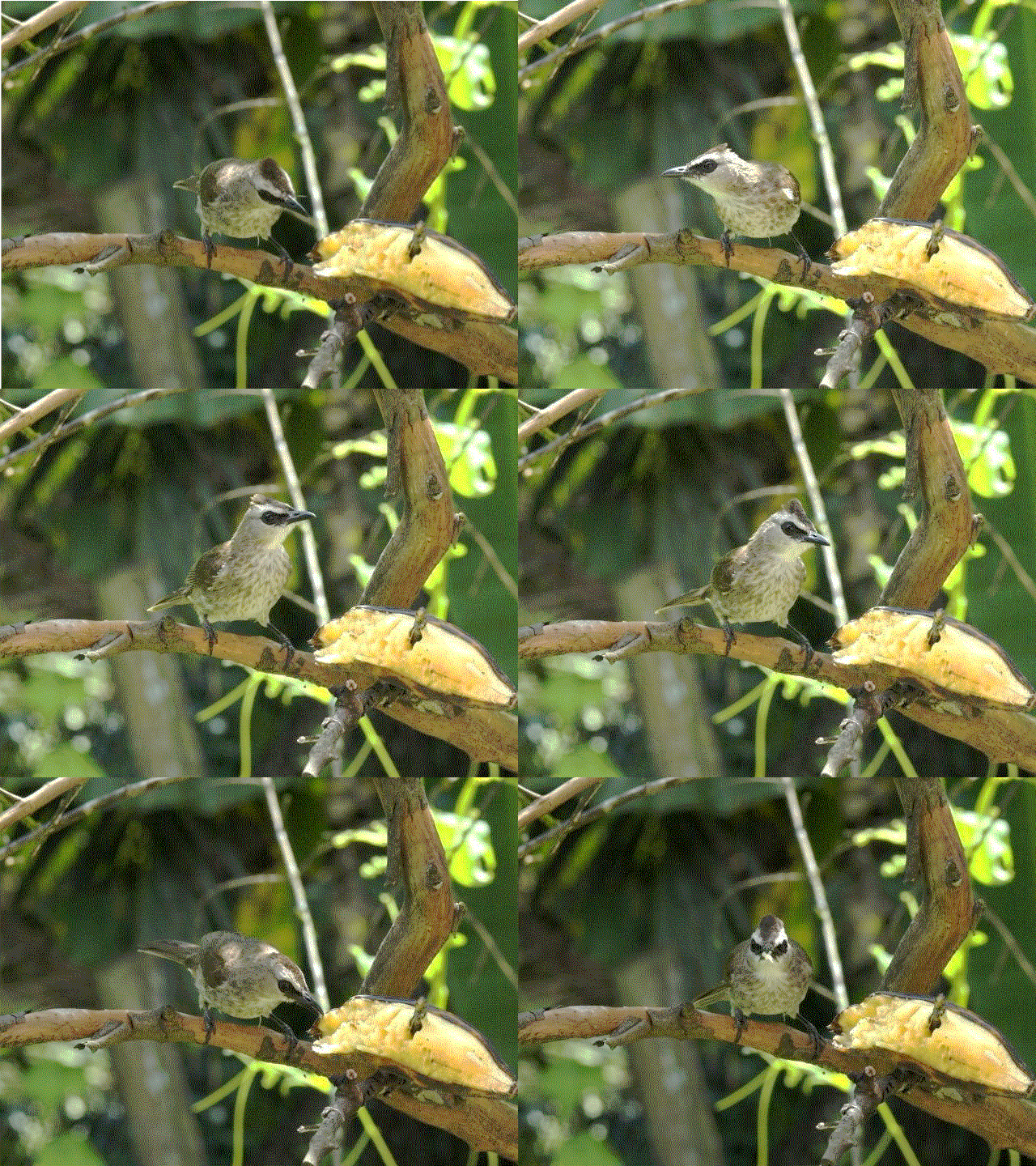
The Ubiquitous Yellow-vented Bulbul


(Click photo to see animation)
The Yellow-vented Bulbul (Pycnonotus goiavier) is one of, if not the commonest bird in Borneo because it is almost impossible not to see one here, whether in the garden, on trees in town, in parks, plantations and at the edge of the forest. It is found almost everywhere except deep in the jungle in most of Southeast Asia including Cambodia, thailand, Peninsular Malaysia, Singapore, Borneo, The Philippines and most of Indonesia. 

This is a species so adapted to humans and cultivated areas that it may even nest in low ornamental plants in your garden. The nest is a "typical" cup shaped nest made of grass, small twigs, vines and leaves. Three to five eggs with lots of reddish speckles are laid. Its food comprise of fruits - berries, cultivated fruits like ripe papaya, guava, tarap and banana.

The above image is that of a bird attracted by a ripe banana placed on my verandah.

Malay name: Merbah kapur.

Saturday, 26 January 2008

The Emerald Dove (Chalcophaps indica)


After the Spotted Dove or Tekukur this bird is perhaps the most common “ground” pigeon on Borneo. And with its emerald green irridescent feathers on its back and wings it is the handsomest too. It is featured on the current RM1 Malaysian postage stamp where it is labelled as "Green-winged Pigeon" a named prefered by many birders, though to me "Emerald Dove" sounds more elegant and befitting this gem of a bird.

Originally a bird of the rainforest and secondary jungle it is now also commonly found in plantations and farms, singly or in pairs on the ground busily looking for food which consist of small seeds, fallen fruits and reportedly, insects including ants and flies. Sometimes it is seen flying low at amazing speed expertly weaving in between trees like a green flying ball. However accidents do occur!

This bird pictured in my hand hit a wall and crashed to the ground dazed, but lucky for it, it soon recovered and could continue its flight but many years ago I had seen one killed outright when it crashed into a chicken wire fence!

Locals sometimes imprison these beautiful birds as pets feeding them rice and chicken feed.

The Malay name for this bird is punai tanah, in Kadazan/Dusun it is limbuken while the Hakkas call it ti kap 地鸽 (simply meaning ground pigeon).

Saturday, 24 November 2007

An Eurasian in Borneo


Believe it or not, the most abundant and visible birds today in our towns, villages and farms, in fact anywhere people live, are not native to Borneo. The Eurasian Tree Sparrow as it is recognised by birders the world over or Ciak Rumah or Pipit Rumah in Malay, is in fact a relatively new arrival in Borneo. I remembered that it was not included in the first edition of Bertram E. Smythies' Birds of Borneo book which I had often borrowed from my uncle as a boy, in fact as any respectable catapult-carrying kampung boy I would have known if there were sparrows living in people's houses then! I had listened enthralled to my dad telling us how he used to trapped "house sparrows" in pre-World War II Singapore!

I believe, it was in the early 1970s that I first set eyes on this species on Labuan Island, and it was much later that I saw a small flock near the port in Kota Kinabalu, from that time its spread was just phenomenal - until today there's hardly any corner of settled Borneo that it isn't found.

Passer montanus was originally native to temperate Europe and Asia but had spread to almost
all over the world including Australia and the US of A where it was said to have been introduced. In their original range Eurasian Tree Sparrows prefer rural areas and nest in trees and hedges while cities and towns are occupied by their relatives the House Sparrows. However in S E Asia where there are no native "house sparrows" they have taken on that role.

Ironically, while the immigrants to this region have continued to thrive and flourish, even to the extend of becoming pests in ricefields and in poultry and ducks farms (where they steal feeds meant for domestic fowls) their population in Europe had declined drastically and in the UK it had been classified as a Red List species, i.e. a species that's "globally threatened, whose population or range has declined rapidly in recent years, or that have declined histrorically and not shown a substantial recent recovery"!