Monday, 21 September 2009

Coelogyne asperata

(Photo 1) Newly opened stalk of flowers

Coelogyne asperata is another beautiful scented orchid found growing on tree branches and rock faces near rivers in the primary forests of Borneo. (See my earlier posts - Perfume in the Jungle and Pigeon Orchid.) It is also found in many parts of Southeast Asia - Peninsular Malaysia, Sumatra, Java, Sulawesi, Philippines, the Moluccas, Solomon Islands and all the way to Papua New Guinea. Alas, as with many other beautiful native plants, it is no longer very common in the wild as more of our forests disappear.
Flies (Photo 2) and a brightly coloured day-flying moth (Photo 3) attracted to the flowers

My photos were taken in my garden where this one plant had lived for years, flowering every once in a long while. Each time it does, whiffs of perfume announce to all and sundry that it's in bloom. Many insects were attracted by the sweet scent - flies, bees, beetles, moths. Many day flying moths and beetles were observed at the flowers but I believe only the bigger flower beetle (Coleoptera - Cetoniidae) that I photographed was an effective pollinator - and I say so because it was seen with the orchid's pollinia (pollens) stuck to its back as it crawled into the lips and column of the flower.
Photo 4 - An equally beautifully coloured flower beetle that's just landed on the flower
Photo 5 - The beetle has crawled into the "heart" of the flower to get at its nectar and
come out with pairs of pollinia stuck to its back (Photo 6) which it would carry to
another flower's stigma to fertilize it.

Saturday, 23 May 2009

Fantastic Fly II

I found another fantastic fly with long eye stalks! Although this guy looks very similar in appearance to members of the Diopsidae (Stalk-eyed Flies Family) it belongs to the family Tephritidae (commonly called Peacock Flies) a group of colourful fruit-flies that do not usually have stalk eyes, so I was told. These photos were taken at the same place where I photographed my first "eye-stalked fly" (see my earlier post Fantastic Fly).

My neice said it looks like a motorcycle (with the eye-stalks as the handles)! So maybe Mat Rempit* Fly or Hell's Angel Fly! I used to think of them as "hammerhead" flies.
I hope some Dipterist (=fly scientist) would see this post and enlighten us on the identity of this fantastic insect.

*Mat Rempit is the Malay word describing the daredevil (illegal) motorbikes racers that plague the streets in many cities and towns in Malaysia.

Saturday, 16 May 2009

Termite Mushrooms a Gift from Mother Earth

Several types of wild fungi or mushrooms are collected for food in Borneo and when in season they may be found at wet markets and more usually in the open-air weekly tamu in Sabah. One favourite and particularly tasty mushroom, Termitomyces clipeatus is called cendawan kaki pelanduk in Malay, meaning "mousedeer hoof mushroom" refering to the shape of the un-opened mushrooms. The Chinese Hakkas call it kai nyuk ku 鸡肉 which means "chicken-meat mushroom" for its sweet taste. Indeed when cooked in soup or stir-fried it tastes a little like chicken!

This species of mushrooms belongs to a group of fungi commonly called Termite Mushrooms. They are so named because they are cultivated by termites inside their nests or mounds in underground fungus gardens! However termites grow and harvest the fungus in its minute mycelium stage without letting it develope into the umbrella-shaped fruiting bodies that we called mushrooms and which we eat! Therefore those growing in the termites' nests are not usually available for human to pick, that is unless the termites for some reasons could not control their growth (for example when it rains too much) when the mycelia will literally grow through the roof of their nest and burst onto the surface of the ground as mushrooms. Which will set us humans into a collecting frenzy!
Apparently species of Termitomyces also grow in the wild without the termites' gardening them and every once in a while, usually after heavy rains or a thunderstorm following a long dry season, hundreds of these mushrooms suddenly appear like magic in patches in the orchard or plantation, even away from termite mounds.
For many Borneans, coming across a patch of these tasty treats would be a thing of joy, friends and any passerbys would be called to join in the gathering, the harvest shared among other friends and relatives, and surplus would be sold in the market. These bonanzas usually last for only a few days, then, again as if by magic they would disappear for months or even years before the next appearence.

Click here for an interesting (and yummy) way to cook this mushroom.

Tuesday, 10 March 2009

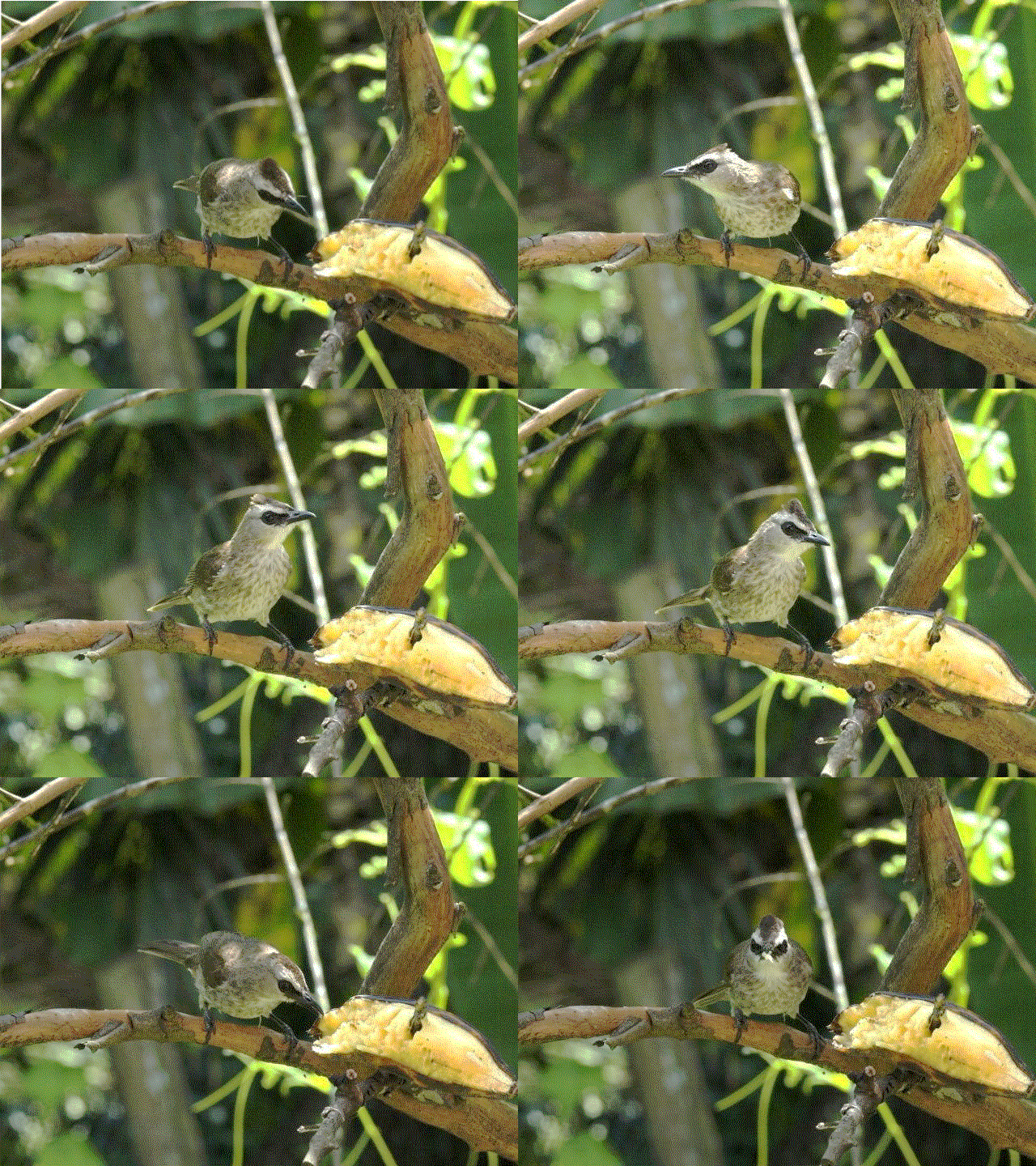
The Ubiquitous Yellow-vented Bulbul


(Click photo to see animation)
The Yellow-vented Bulbul (Pycnonotus goiavier) is one of, if not the commonest bird in Borneo because it is almost impossible not to see one here, whether in the garden, on trees in town, in parks, plantations and at the edge of the forest. It is found almost everywhere except deep in the jungle in most of Southeast Asia including Cambodia, thailand, Peninsular Malaysia, Singapore, Borneo, The Philippines and most of Indonesia. 

This is a species so adapted to humans and cultivated areas that it may even nest in low ornamental plants in your garden. The nest is a "typical" cup shaped nest made of grass, small twigs, vines and leaves. Three to five eggs with lots of reddish speckles are laid. Its food comprise of fruits - berries, cultivated fruits like ripe papaya, guava, tarap and banana.

The above image is that of a bird attracted by a ripe banana placed on my verandah.

Malay name: Merbah kapur.

Sunday, 22 February 2009

Perfume in the Jungle

It is estimated that  over 3,000 species of orchids can be found in the wild in Borneo. However as the "wild places" of Borneo shrink many of these treasures, together with countless other plants and animals will inevitably become lost. One previously common fragrant orchid is the Necklace Orchid - Coelogyne rochussenii which is usually found growing on trees, sometimes rocks, overhanging rivers. Due to land clearing, river banks are now mostly treeless and so this orchid is now more often seen in somebody's garden! 
Like the common Pigeon Orchid this orchid  only flowers occassionally  but when it does the whole neighbourhood would be filled with a very strong and sweet scent. However unlike the flowers of the Pigeon Orchid, the blossoms and scent of the Necklace Orchid last for over a week. 

Coelogyne rochussenii (which was named after the wife of a certain Monsieur Rousseau who was a French Orchid Enthusiast in the 1800s) is also found in most of Southeast Asia, including Thailand, Peninsular Malaysia, Sumatra, Java, Sulawesi, and the Philippines.

Saturday, 7 February 2009

The Sun Bear

Although it is the smallest bear species in the world the Sun Bear (Ursus malayanus also Helarctos malayanus) is Borneo's largest carnivore. However, unlike tigers which are absent in the wild from Borneo, it feeds mainly on small animals like rodents, birds and insects and their diet also consists of a large part of plant material including fruits and hearts of palms. It is also very fond of termites which it catches by tearing up their nest with its strong claws. 
Sun bears (called beruang in Malay, bawang or buang in Kadazan and Dusun, jugam or makup in Iban) are seldom seen by people as they are mainly nocturnal forest animals. And like many wild animals sun bears are threatened with extinction due to loss of habitat caused by human activities. My photo is taken at the Lokawi Wildlife Park near Kota Kinabalu in Sabah. Although it is sad to see animals in captivity, zoos, I believe are necessary for the education of the public about the animals in our dwindling forests. 

Sun bears are found in Southeast Asia, including Borneo, Malay Peninsula, Burma, Bangladesh, Laos, Cambodia, Vietnam, Thailand and Sumatra.

Friday, 16 January 2009

Fantastic Fly

So far I have not posted any photo of Borneo's insects, not that we don't have our share of interesting insects, in fact our island is one of the richest places on earth entomologically! So to be fair to the millions of insects my new year's first post is about one of their kind!
Here's a fly! It may not look like one, reminds you of a hammer-head shark, doesn't it? But it's a member of the Diopsidae family in the Order Diptera, thus it is a true fly. Several species of stalk-eyed flies are found in Borneo, but due to their small size, they are seldom noticed.
I have not been able to get this specimen identified to its genus and species, but would post its ID here as soon as I got it. In the mean time I would welcome any comments or help in identifying this fantastic looking creature (some may say weird, but I think it's just wondrous looking, quaint, if you like but definitely not weird).

Saturday, 13 December 2008

Banded Bullfrog - Another Eater of Ants

The Banded Bullfrog (Kaloula pulchra) is very similar to the Brown Bullfrog (K. baleata) in both appearance and habits. (See my previous post of 23 December 2007) It can be recognized from the latter by the wide yellow band on its sides and by its slightly bigger size.
This species is said to be a recent introduction in Borneo and is a frog of human settlements living under rubbish heaps and other debris in town and cities. They emerge in big numbers after a heavy rain to form large noisy breeding groups in flooded drains and ponds. Males inflate themselves into balls as they calls while floating on the water surface.

Ants, as my photos (taken in my brother's house on Labuan Island) show, are their almost exclusive food.


Saturday, 8 November 2008

Nocturnal Tarap Eater

One of the animals that come to eat the tarap fruits at night in my backyard that I was able to photograph is the Common Palm Civet (Paradoxurus hermaphroditus). Possibly another species of civet - the Malay Civet (Viverra tangalunga) also does so though I've never seen it.

A nocturnal omnivore, the palm civet hunts alone. They are expert climbers and spend most of their lives in trees. They eat small vertebrates, insects, ripe fruits and seeds. They are very fond of palm sap, therefore their common name. The sap is used by natives to make a sweet liquor called "toddy", which gives the palm civet its other common name. The palm civet is also fond of coffee cherries. They eat the outer fruit and the coffee beans pass through their digestive tract. An expensive coffee called kopi luwak is supposedly made from these coffee beans. Kopi luwak is said to have a gamy flavor and sells for more than $100 per pound.


More Tarap Eaters


The biggest of the birds that come to the feast is the Oriental Pied Hornbill (Anthracoceros albirostris), there's a semi-resident pair of them in the neighbourhood.


At least two species of bulbuls - the Olive-winged (Pycnonotus plumosus) (above)  
and the very common Yellow-vented (Pycnonotus goiavier) (below)
 

The smallest - the Orange-bellied Flowerpeckers (Dicaeum trigonostigma)
sometimes feed on the wing, hovering like humming birds. The photo below is 
that of a female (or possibly a juvenile). The bottom photo shows a mature male.